
Business Central is gradually evolving from an ERP system for accounting and business management into a platform where artificial intelligence helps not only analyze data but also carry out operational tasks.
At Directions EMEA 2026, held in Paris on October 27-29, Microsoft and its partners demonstrated new use cases for Copilot, AI agents, integration with Microsoft Fabric, and business process automation.
The SMART business team attended the conference and identified the key technology changes that may affect companies working with Business Central. Here is what was presented, which capabilities are already available, which are still in development, and what this means for businesses.
How AI expands Business Central’s capabilities: Copilot, intelligent agents, and new ways of working
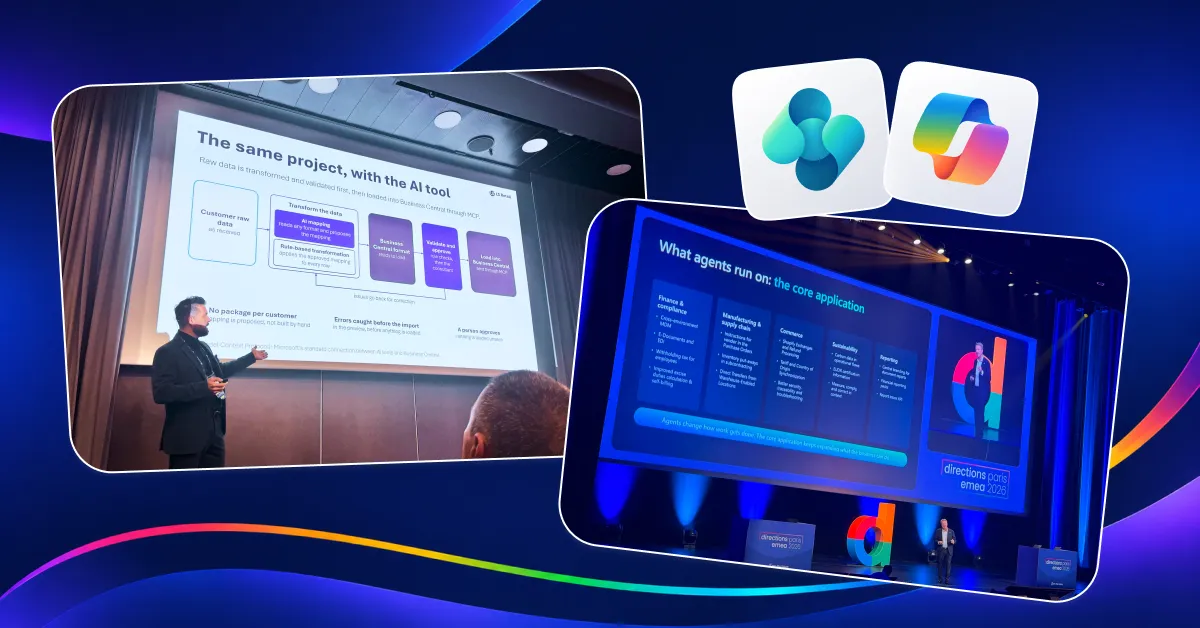
One of the central themes of Directions EMEA 2026 was the shift from using artificial intelligence to find information and draft answers to integrating it directly into company workflows. In Business Central, this is developing along several lines at once: Copilot is gaining more ways to interact with data, specialized agents are taking on individual operational tasks, and new tools are helping coordinate work across different systems.
Copilot doesn’t just answer, it takes action
The demonstration of data editing with Copilot was particularly telling. Microsoft showed how a user can ask Copilot, with a plain text instruction, to find a specific customer’s order and change its delivery date. The system finds the right record, identifies the relevant field, and performs the required action.
This changes the usual way of interacting with an ERP: instead of searching for the right section, record, and field on their own, users can describe the desired outcome in natural language. This functionality is not yet available in standard Business Central; its release is planned for approximately April 2027. However, SMART business clients don’t have to wait for the official release: a similar scenario can already be implemented now with a custom solution.
At the same time, Copilot does not get unrestricted access to the system; it acts within the permissions of the specific user. For example, when data is to be deleted, the system asks for confirmation, and all operations performed are recorded in a log, including at the level of individual fields.
For businesses, this combination of convenience and control matters. Automation should not bypass existing data-handling rules and control mechanisms, since they are what makes an ERP system reliable.
Agents take over individual business processes
AI agents remain one of the strategic directions for Business Central’s development. At Directions EMEA 2026, the company introduced the Expense Agent, an agent that automates employee expense tracking, including for business trips and travel. This is a new scenario for Business Central, in which an AI agent is the foundation of the process automation from the start.
The Expense Agent recognizes receipts, extracts key data from them, determines expense categories, and matches them with corporate card transactions. Based on this information, it generates reports that take the company’s internal policies into account.
Employees don’t need access to Business Central: they can submit receipts through a web app, Outlook, or a mobile app, and review reports and submit them for approval through Microsoft Teams. This approach makes it possible to involve employees who don’t need constant access to the ERP. The agent prepares the data and helps ensure compliance with established rules, but the final decision on approving expenses remains with a responsible person.
Copilot Cowork: Cross-system interaction and a new approach to analytics
Another group of Microsoft announcements concerns the integration of Business Central with Copilot Cowork. This tool is designed to coordinate more complex tasks across multiple applications, drawing on data from the ERP, email, Outlook, and Teams. Specialized agents perform individual operations in Business Central, while Cowork helps combine them into broader work scenarios.
In the demonstration, Microsoft showed how Cowork can collect information from various Business Central tables and use it to create an interactive cash flow visualization. In the example, data from another company was also added, and the figures were consolidated across different currencies. According to Microsoft’s estimate, preparing a similar report manually in Excel could take 60-80 hours.
Another change matters for users: interaction with the ERP may gradually move beyond Business Central’s familiar interface. For example, instead of building a report themselves, a user will be able to ask a question in natural language and get an answer based on the system’s data without opening the system directly. In retail, these could be queries about products that sell well in some stores but pile up in the warehouses of others, or comparisons of sales across different periods. In this model, data quality, consistency of business logic, and reliability of integrations become especially important: they will determine how useful the AI’s answers and actions are.
Microsoft announced that a preview of the Business Central integration with Copilot Cowork for partners is expected in late November or early December 2026.
Business Skills: Business rules as the foundation of AI’s work
Another direction presented was Business Skills. It makes it possible to describe a company’s policies, procedures, and internal rules in natural language so that Copilot and agents can take them into account when performing tasks in Business Central. Partners will also be able to create and reuse sets of such skills for typical industry scenarios.
The conference also featured examples of using AI tools to speed up the setup of industry-specific solutions. In particular, LS Retail showed scenarios using MCP and Claude to configure a restaurant and a grocery store. Put simply, AI can be used to set up the system much faster for the needs of a specific venue: describe its business processes, prepare the necessary parameters, and adapt the solution to the specifics of its operations. This is a broader example of how AI can change not only users’ day-to-day work but also approaches to implementing business systems.
How AI is changing approaches to implementing Business Central
The development of AI affects not only Business Central’s functionality but also how ERP systems are implemented. At Directions EMEA 2026, a separate session was devoted to this topic, “15 Tips & Tricks to Start Consulting with AI in Business Central,” which covered practical scenarios for using AI in consultants’ work.
This is not just about generating code or automatically creating documents. AI can help at different stages of a project: analyzing information about the client’s business, structuring meeting outcomes, preparing requirements and functional specifications, creating test scenarios, and supporting data migration. This makes it possible to reduce the time spent on preparation, documentation, and repetitive tasks and gives consultants more room to focus on more complex issues: understanding business processes, choosing the solution architecture, aligning requirements, and controlling implementation quality.
At the same time, faster development does not necessarily mean that ERP projects will become shorter or simpler. If building additional functionality takes less time and fewer resources, companies may more often choose custom solutions instead of adapting their own processes to the system’s standard capabilities. As a result, projects may become richer in business logic, integrations, and specific requirements, even with a relatively small number of users.
This will also change the role of the implementation team. Less time may be spent on writing code, and more on clarifying the business’s real needs, designing solutions, reviewing generated code, and assessing its impact on future support and system updates. Developers will increasingly act as specialists who verify the results of the AI’s work, assess their compliance with the system architecture, and take responsibility for the quality of the final solution.
Business Central and Microsoft Fabric: Easier access to data for analytics
Another important announcement at Directions EMEA 2026 concerned the integration of Microsoft Dynamics 365 Business Central with Microsoft Fabric. Microsoft introduced native data mirroring: companies will be able to select the Business Central environments and tables they need and send them to OneLake, the unified data store in Microsoft Fabric.
This will make it possible to use Business Central information in other tools in the Microsoft ecosystem: for example, to build reports and visualizations in Power BI or to combine ERP data with other sources for comprehensive analytics. An important feature of the new approach is that mirroring does not require the Business Central API, so this mechanism does not consume the corresponding API limits.
This may be especially relevant for companies that need to combine data from several systems, analyze different lines of business, and get information for management decisions faster.
What the SMART business team took away from Directions EMEA 2026
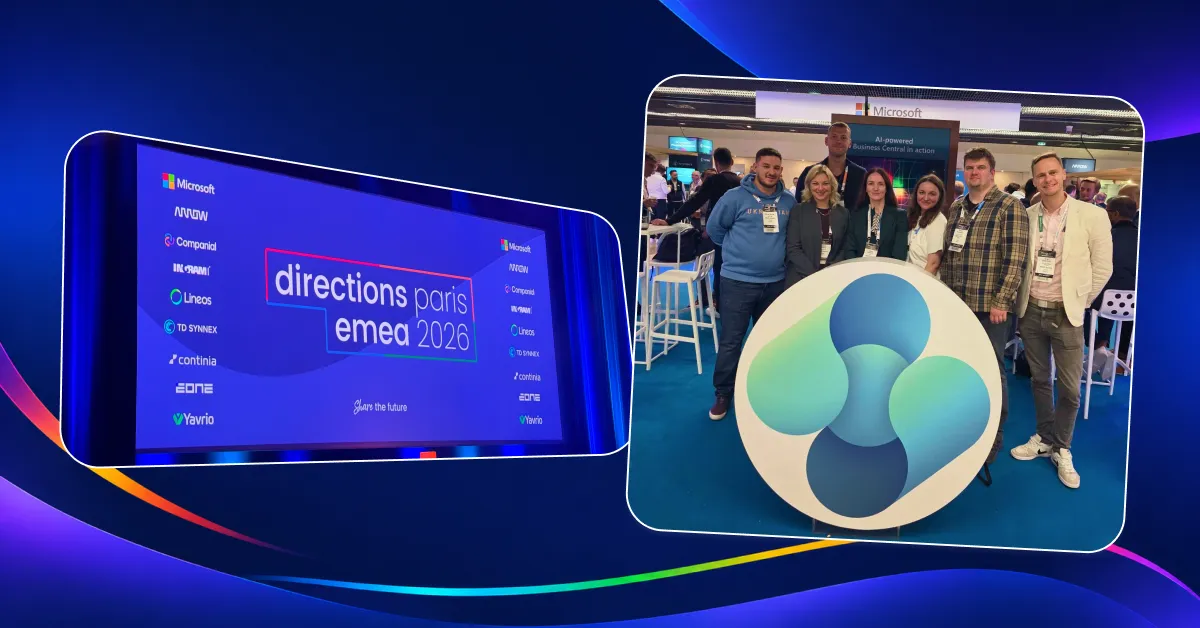
The team paid particular attention to how the new AI capabilities can be applied in SMART business’s own solutions. This is not only about using Copilot to interact with data, but also about automating individual operations, simplifying system setup, and supporting users in their daily work.
The discussions at the conference also suggested new development paths in several areas, including integration of Business Central with Jira, Quality Management solutions, banking solutions, and more. The team has taken these areas forward for further work, based on client needs and the platform’s capabilities.
The impact of artificial intelligence is becoming evident not only in the development of Business Central’s functionality but also in the transformation of the ERP implementation process itself. AI is changing approaches to business process analysis, requirements work, and the development and testing of solutions. SMART business is also an active participant in this transformation: the team continually explores new capabilities, adapts approaches in its own projects, and adopts tools that help improve the quality and efficiency of its work. SMART business will certainly continue to share these changes, its own experience, and its practical results with the professional community.
Directions EMEA 2026 allowed the SMART business team not only to learn about Business Central’s new capabilities but also to better understand how the ERP market is changing in the age of artificial intelligence. At the same time, it is important that the new capabilities don’t remain mere technology announcements. SMART business regularly shares information about Business Central’s development with its clients and the professional community. We help assess the practical value of new features and find ways to apply them in real business processes. After all, a technology partner’s task is not just to implement new tools but to help companies get tangible results from them.