
ABB is a bank that actively invests in modern financial solutions, ensuring stability, innovation, and reliability for millions of its customers. In 2024, the international magazine Euromoney named ABB the Best Digital Bank in Azerbaijan. Moreover, the Deloitte Digital Banking Maturity 2024 study — which assesses the level of digital development of banks in 44 countries — confirmed ABB’s leadership in digital financial services at the national level. ABB also promotes its digital culture and technological vision through educational and industry initiatives. In December 2024, the bank organized the country’s first Data & AI Summit, which brought together over 250 participants from Azerbaijan and abroad to discuss the future of data analytics, artificial intelligence, and digital customer experience.
Global Finance magazine has recognized ABB as the recipient of the “Best Consumer Digital Bank” and “Most Innovative Consumer Digital Bank” awards in Azerbaijan in its “World’s Best Digital Banks 2026” ranking. It is worth noting that ABB has also been awarded the “Bank of the Year in the Country” title by Global Finance, Euromoney, and The Banker magazines.
ABB Bank aims to be one of the national champions in the application of artificial intelligence technologies, building the future of banking together with its customers. As part of its new development strategy for 2026-2028, ABB has adopted the “Artificial Intelligence and Generative Artificial Intelligence” Roadmap. Based on this roadmap, the bank applies artificial intelligence solutions not only in customer-facing services but also extensively in employees’ daily activities, back-office operations, and risk management.
ABB Bank was applying more than 180 AI models across more than 86 user scenarios, with these solutions generating a positive financial impact of more than AZN 50 million. ABB completed the installation of a high-performance AI server at its data centre based on the Dell PowerEdge XE9780 platform and equipped with eight NVIDIA HGX B200 GPUs. The infrastructure is designed to support large language models, AI agents, model inference and training, as well as other high-performance computing applications, while enabling sensitive data to remain within the country.
At the beginning of 2026, ABB introduced its AI assistants, AI-khan and AI-nur, to all its customers.
ABB’s success in digitalization and innovation requires reliable and scalable technological solutions. That’s why the bank decided to migrate from the previous system, which could no longer support efficient management amid the growing complexity and scale of operations. The new solution became a modern, flexible, international-level platform — Microsoft Dynamics 365 Business Central. This move made it possible to unify procurement, finance, and HR within a single system, improving management efficiency, data accuracy, and process transparency across all levels of the organization.
ABB’s Business Processes Before Microsoft Dynamics 365 Business Central — and the Reasons Behind the ERP Migration
Before the implementation of Microsoft Dynamics 365 Business Central, ABB used a legacy system to manage finance and operational processes, which, despite providing basic automation, no longer met the organization’s requirements for scalability, integration, and data accuracy. Payroll processing was slow, and communication between HR and other departments required additional effort and resources. Procurement processes were dispersed across multiple systems, making it difficult to control expenses and plan resource needs efficiently. The lack of a centralized data repository limited quick access to up-to-date information, complicated analytics and planning, and created additional risks of inaccuracies in reporting.
All these factors became key drivers behind ABB’s decision to seek a modern solution for managing its internal business processes. The goal was clear: to integrate finance, HR, and procurement into a single, flexible system; to increase the speed and accuracy of operations; to ensure transparency and control at every level; and to build a solid foundation for future digital development and scalability. That’s why ABB chose Microsoft Dynamics 365 Business Central — an enterprise-grade platform capable of supporting the bank’s complex and fast-growing operations. Compared to the prior system, the Microsoft platform offered a number of significant advantages:
| System Name | Former system | Microsoft Dynamics 365 Business Central |
| Payroll Automation | Partial, requires manual adjustments | Full automation with fast and accurate calculations |
| HR & Finance Integration | Limited, fragmented data | Full integration within a single system |
| Procurement Management | Fragmented | Centralized, transparent, and equipped with advanced analytics tools |
| Data Access | Limited, difficult to retrieve up-to-date data | Fast access to all data at any time |
| Scalability | Difficult to maintain as the bank grows | Flexible, suitable for a large and distributed network |
| Analytics & Reporting | Limited functionality | Advanced, customizable, and predictive |
| Decision-making | Slow due to manual processes | Accelerated, based on real-time data |
Above all, ABB’s choice of Microsoft Dynamics 365 Business Central was driven by the fact that SMART business offered ready-made industry-specific solutions that were perfectly aligned with the bank’s needs. Another decisive factor was the partner’s deep expertise in business process design and system implementation. This allowed for minimal customization, making the deployment faster and more efficient than further adaptation of the existing system.
The existing solution covered only part of our needs, and we felt limitations in terms of scalability. With Microsoft Dynamics 365 Business Central, everything changed — we now have a platform that not only automates internal operations but also lays the foundation for the bank’s future growth and digital transformation.
To deliver the project, the bank chose SMART business — a company with international expertise and many years of experience in ERP implementation. SMART business has already completed several projects in the financial sector in Azerbaijan and has a strong track record of successful cases in the banking industry. As a result, ABB gained not only a world-class technological solution but also a reliable partner for its comprehensive digital transformation.
Implementation Stages, Results, and the Key Priorities for ABB Bank
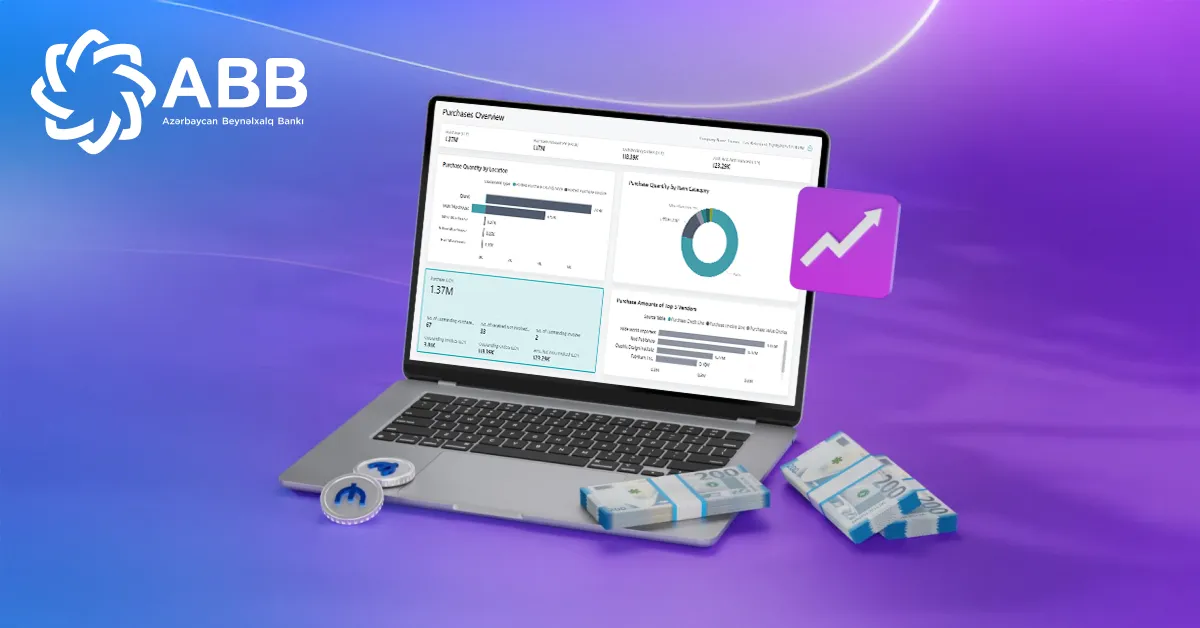
Before implementing Microsoft Dynamics 365 Business Central, the ABB team had a number of clear expectations. For the bank, it was critical to establish efficient resource management accounting — consolidating all employee data in a single system, ensuring automated payroll calculations, and enabling accurate vacation tracking. Together with the vendor, several mission-critical priorities were defined — these became the foundation of the entire transformation.
First and foremost, the goal was to reduce financial and administrative costs, enhance transparency and process security, and increase the speed of decision-making. For a large bank with over a hundred branches across the country, this was essential: any delays in internal operations directly affected both efficiency and the quality of customer service.
Particular attention was given to automating procurement — one of the bank’s most sensitive and resource-intensive areas. In the previous system, managing requests and approvals was complicated and required extensive manual work, which created risks of duplication, delays, and inefficient use of funds. Microsoft Dynamics 365 Business Central enabled ABB to completely rebuild this process, making it transparent, controlled, and fast.
The system provided:
- Convenient request creation — employees from any department can easily submit purchase requests using a simple and intuitive form.
- Multi-level approval — requests go through multiple approval stages with clear deadlines and built-in tools for monitoring bottlenecks.
- Managerial control — supervisors can instantly assess the necessity of a request and prevent unjustified expenses.
- Process flexibility — if a responsible person is on leave or unavailable, the request doesn’t get stuck: the system automatically delegates it to a predefined substitute. This prevents delays and ensures continuous approval flow, guaranteeing that the process always moves forward.
- Optimized workload in the procurement department — managers can distribute requests among specialists based on their current workload.
- Cost optimization — before approving a purchase, the system checks whether the required items are already available in the bank’s warehouses or other branches. This helps avoid unnecessary expenses and ensures efficient use of internal resources.
- Efficient supplier management — the system enables easy supplier selection, contract handling, cost control, and even aggregation of multiple requests into a single order.
- Price control — in case of price fluctuations, the system allows setting acceptable deviation thresholds. For example, a 1% price change doesn’t require full re-approval of the request, significantly speeding up the process.
- End-to-end monitoring — from submission to delivery, employees can see the real-time status of their requests, including deadlines, responsible persons, and delivery confirmations. The system tracks completion timelines at every stage and notifies users if a request becomes stalled.
- Integration with accounting and treasury — all payments are now directly linked to orders, and payment orders are generated automatically. Once a purchase request is approved, the treasury department instantly receives all payment data — no duplicate data entry required. This minimizes errors, accelerates processing, and additional verification layers ensure financial security.
- Regulatory compliance — the system allows attaching scanned copies of signed paper documents, which is a mandatory requirement of the Central Bank of Azerbaijan.
Budgeting: The Next Step After Procurement Automation
The implementation was carried out in several phases. The first focused on the procurement and treasury modules, which allowed the team to quickly address the bank’s most critical operational needs.
The next step was the introduction of budgeting, which brought an even higher level of financial discipline: each purchase request is now linked to approved budget items and automatically reserves funds, preventing overspending.
How it works:
- Budget request creation — at the planning stage, the bank prepares annual budget requests for all key expense categories.
- Linking to budget items — every purchase request that enters the system is automatically checked to ensure funds have been allocated in the budget. If the budget is not approved or exceeds its limit, the system simply won’t allow the request to proceed.
- Fund reservation — once a request is approved, the corresponding amount is immediately reserved in the budget. This eliminates the risk of spending beyond planned limits.
- Full transparency — bank management can see in real time which budgets have already been used, which remain open, and which obligations are reserved for upcoming purchases.
Thus, the budgeting module has transformed the procurement process into a fully controlled cycle — from strategic planning to final settlement with the supplier.
The key result was the creation of an end-to-end process — from submitting a request to the actual receipt of goods or services. The employee who initiated the request can track its status at any time, see responsible parties, and receive notifications once it’s completed. This approach has greatly improved transparency, minimized the risk of unapproved spending, and ensured strict adherence to budget limits.
In addition, Microsoft Dynamics 365 Business Central was integrated with the bank’s internal accounting system for payment operations. This eliminated the need for manual data duplication or re-entry of transactions — all financial operations are now fully synchronized, and the risk of errors has been reduced to a minimum.
Challenges During Migration to the New System — and How They Were Overcome
The transition from one system to another is always associated not only with technological tasks but also with organizational challenges. The scale of ABB Bank’s operations and the involvement of multiple departments required clear coordination and alignment with the vendor’s team.
At the initial stage, the greatest difficulty was that for a certain period, operations had to be run in two systems simultaneously. This created an additional workload for employees, who had to maintain ongoing processes in the old system while adapting to the new platform. Each business process had to be compared with Microsoft Dynamics 365 Business Central’s capabilities, optimal scenarios defined, and the necessary adjustments made to meet the bank’s specific needs. This required attention to detail and deep coordination between both the client and the integrator. However, this transition phase was essential to build a modern digital ecosystem.
Another challenge was the need to coordinate workflows between different departments — from accounting and procurement to administrative and HR divisions. During implementation, each department had its own priorities and expectations, which could have complicated achieving a unified result.
To prevent confusion, ABB management established a dedicated “working group”, consisting of representatives from key departments. They met weekly to discuss tasks, review current progress, and agree on next steps. This open, collaborative format helped form a shared vision and gradually synchronize processes. Thanks to careful planning, continuous support from SMART business, and transparent two-way communication, the project achieved its main goal — a smooth transition without disruptions or employee resistance.
Today, we can confidently say that the temporary challenges our team faced during the migration were simply a step toward meaningful transformation. They proved that even the largest-scale change is possible when expertise, a shared vision, and clearly defined goals come together.
After overcoming the challenges and completing the adaptation process, ABB Bank was rewarded with tangible improvements across several key areas:
- Procurement and Administrative Processes — The system made it possible to completely rebuild the interaction chain — from submitting a request to organizing warehouse operations. The bank now has centralized control over all stages: from ordering goods and services to accounting and analytics. This has increased process transparency, reduced the risk of duplicate requests, and accelerated internal approvals.
- HR and Payroll — Thanks to automation, manual input errors have been eliminated, and vacation tracking has become simpler and more transparent. All personnel data is now consolidated in a single database, ensuring quick access to up-to-date information and easing the workload of the HR department.
- Data Access and Reporting — Previously, collecting and reconciling data from multiple sources required significant time and effort. Now, Microsoft Dynamics 365 Business Central provides the bank’s management with real-time insights at any moment. This allows them not only to respond to current needs but also to build long-term strategies based on complete and accurate data.
As a result, Microsoft Dynamics 365 Business Central has become a single digital tool for transparent management of internal processes. It helped optimize routine operations and laid the foundation for the bank’s further development.
For us, this project proved that even within large organizational structures, it is possible to build a unified system that connects various processes and departments. The challenge was not about implementing functionality itself but about ensuring transparency and synchronization across the entire bank team. Today, ABB has a tool that makes its internal operations controlled, timely, and aligned with real business needs.

Want your processes to be automated, transparent, and fully under control? The SMART business team is ready to become your partner in implementing modern solutions! We don’t just deploy software — we share our cross-industry expertise, giving customers added value and helping them get the most out of every project. Request a demo today and start building your own success story!