ERP systems are entering a new stage of evolution — the AI-powered era, where artificial intelligence becomes an active participant in business processes. According to the Microsoft Work Trend Index, over the next 2–5 years most companies will be on a path toward transforming into so-called Frontier Firms — organizations that operate through close collaboration between people and AI agents. The numbers speak for themselves:
- 82% of executives believe this is a critical moment to rethink key aspects of strategy and operations.
- 81% expect AI agents to be embedded into corporate strategies within the next 12–18 months.
- Adoption is accelerating: 24% of companies report that AI is already deployed across the entire organization, while only 12% remain in pilot mode.
Additional insights shared by Charles Lamanna, President, Business & Industry Copilot at Microsoft, further reinforce this shift. According to him, more than 70% of companies are already applying AI across core functions — from customer service and marketing to IT, product development, and cybersecurity. Another notable trend is that 67% of organizations are already turning industry-specific AI use cases into real revenue growth drivers.
These trends clearly indicate that businesses are moving beyond experimentation toward systematic use of artificial intelligence. This is where Microsoft Dynamics 365 Business Central stands out. As a modern ERP solution for managing finance, operations, and supply chains, Business Central already offers AI agents that can be activated directly within the system environment. AI agents in Business Central unlock a new level of efficiency: they take over routine operations, accelerate managerial decision-making, and integrate seamlessly into core ERP business processes. As a result, the system evolves into a platform where artificial intelligence works alongside professionals — boosting team productivity and enabling strategic agility.
What Is Agentic AI ERP?
The concept of agentic AI ERP represents a natural evolution of automation systems. Where ERP once flawlessly executed clearly defined algorithms and scenarios, today it is gaining the ability to operate independently within context. An ERP system is no longer limited to carrying out commands “from point A to point B”; instead, it demonstrates a deep understanding of business logic. AI agents do not wait for detailed instructions for every operation — they can analyze incoming data, independently determine task priorities, and choose the optimal course of action within established business rules.
In essence, this marks a shift from a tool in the company’s hands to a partner the business collaborates with. Rather than serving merely as a platform for transaction processing, agentic ERP becomes an intelligent environment that proactively supports the team. Agents act as “digital employees”: they identify connections across fragmented data, anticipate needs, and lay the groundwork for the final decision made by a human. This approach transforms ERP from a system of record into a full-fledged engine of growth, where technology becomes an active driving force — freeing professionals from cognitive overload.
AI Agents in Microsoft Dynamics 365 Business Central: Role and Business Benefits
Microsoft emphasizes the practical application of AI in Microsoft Dynamics 365 Business Central — from generative Copilot tools to autonomous agents that handle portions of daily operations. This lays the foundation for a new level of efficiency, allowing users to activate ready-to-use agents immediately and oversee their work directly within the ERP system.
Copilot in Business Central
Every user of Microsoft Dynamics 365 Business Central has access to Copilot — an AI-powered assistant that helps quickly find information, analyze data, and generate recommendations and insights. Copilot is included as part of the solution for every Business Central user, with no additional setup or costs required.
Beyond its core functionality, Copilot offers advanced capabilities for working with data. It reduces the time needed to spot trends and detect deviations in business metrics, delivering insights directly within the system interface in a convenient format. Users can make simple natural-language queries, such as: “Show suppliers by region, sorted by purchase volume,” and instantly receive a ready-made analytical view — no complex configurations or separate reports needed. These capabilities enable more agile management: companies can quickly identify which suppliers service specific warehouses, assess collaboration effectiveness, and make informed decisions about optimizing supply chains or revising contract terms. Features like these reduce team workload and accelerate managerial decision-making.
AI Agents in Business Central
AI agents play a key role in transforming ERP by automating critical business processes:
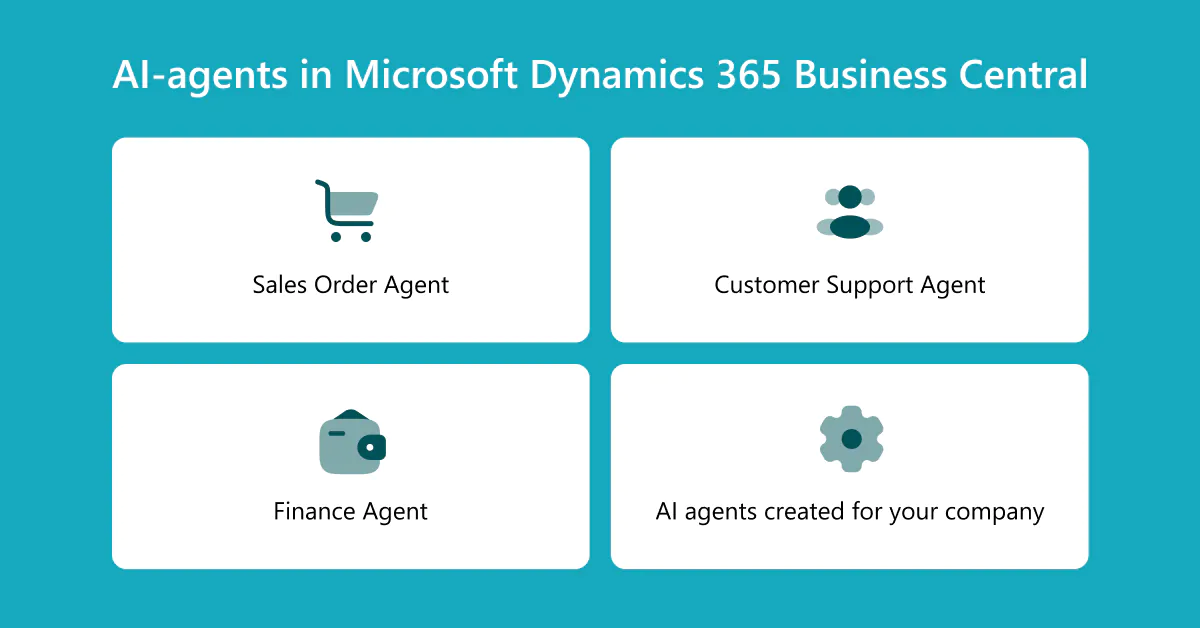
- Sales Order Agent — a tool in Microsoft Dynamics 365 Business Central that optimizes order management, interprets data from emails, and generates sales documents. This agent reduces manual work and accelerates the cycle from order receipt to fulfillment. It analyzes incoming customer requests received via email and automatically matches them with system data. If information is missing or multiple options exist, the agent initiates clarification via email to gather all necessary details. It can check product availability and generate a structured commercial offer. By handling the entire order process, the Sales Order Agent reduces turnaround time, minimizes manual operations, and ensures transparency for the customer, resulting in faster service, fewer errors, and a more professional client experience.
- Customer Support Agent — helps support teams respond quickly to customer inquiries, locate the right information in the system, and escalate complex cases. This approach improves service quality and shortens response times.
- Finance Agent — analyzes financial transactions, generates reports, and optimizes expenses. This provides finance teams with tools for more accurate transaction control, expense management, and cash flow and budget forecasting.
The AI-powered agents in Microsoft Dynamics 365 Business Central can be quickly activated through standard system settings. Importantly, agents operate under user supervision: the system generates recommendations, but the final decision remains with the human user. This approach combines automation with transparency and managerial control.
Custom AI Agents in Business Central
For companies with specific processes, Microsoft Business Central allows the creation of custom AI solutions that can be integrated into Microsoft’s broad cloud ecosystem. This means the system can adapt to industry-specific scenarios, rather than just working with standard functionality.
Want to implement an AI agent tailored to your company’s needs? Explore the AI agent capabilities from SMART business, or submit a consultation request — our team of experts can help you deliver projects of any complexity.
AI Agents in Business Central: Easy Integration — Real Business Impact
To operate at peak efficiency, AI agents need access to company data: customers, products, orders, and more. The MCP (Model Context Protocol) Server in Business Central acts as a “bridge” between the ERP system and the agents, providing secure, consistent, and convenient access to company data.
Business Value
- Quick onboarding and minimal maintenance costs — any agent built on Microsoft platforms or other solutions can work with Business Central data without complex integrations.
- Real-time synchronization of actions and knowledge — all changes made by agents (e.g., creating an order, updating customer data, or checking inventory) are immediately reflected in Business Central. Users see up-to-date information without delays, and agents always work with the latest data. This reduces errors, eliminates duplicated work, and ensures alignment between business processes and teams.
- Flexibility and control — companies define what actions agents can perform: whether just viewing data or also creating, modifying, and deleting information. This gives full control over how agents interact with the system.
In other words, MCP (Model Context Protocol) is an open API standard that defines how applications pass context to language models. This allows agents to “understand” business data and work with it in a plug-and-play format. If an agent complies with MCP requirements, it gains access to rich context and can operate at maximum efficiency.
Research data from Microsoft shows that companies already operating as Frontier Firms — actively integrating AI into their processes — demonstrate significantly better results. Executives in these organizations largely rate their business as successful (over 70%), compared to an average of around 40% globally.
Employees in these companies also report the ability to take on more meaningful work: over half of employees in Frontier Firms say they can handle more responsibilities, while globally, only about a quarter report the same. Additionally, nearly 9 out of 10 employees (90%) in these organizations feel they are performing work that has real business value, compared to around 77% globally. These results highlight that AI integration not only reduces routine workload but also creates conditions for more productive and meaningful team activities, directly contributing to company success.
Real-World Use Cases of AI Agents: Insights from Global Brands
The Microsoft article “Bridging the AI divide: How Frontier Firms are transforming business” provides an example from Mercedes-Benz, demonstrating how AI can transform manufacturing at a global scale. The company integrated AI across its production network, covering more than 30 factories in multiple countries. For employees, a full ecosystem of chatbots called “Digital Factory” was created, providing shared insights and support in daily work. In other words, employees have a “smart assistant” that suggests where processes can be optimized or issues avoided.
Another case highlighted in the Microsoft blog is Dow, a chemical corporation that processes over 100,000 delivery invoices annually, where AI agents became a key efficiency tool. In Copilot Studio, an agent was created to automatically check invoices for errors and flag them in the system for further review by employees. The agent enables rapid detection of pricing inaccuracies and prevents hidden losses. Previously, identifying such issues could take weeks or even months, but now the process is completed in minutes.
Additionally, the company uses a Freight Agent, which allows specialists to “interact with data” using natural language. Instead of writing complex queries or manually analyzing information, employees can ask questions in plain language and instantly receive answers. Dow anticipates that these tools will save millions of dollars in the first year of use alone.
Another standout example from Microsoft is the collaboration with the globally renowned brand Ralph Lauren, for which the innovative “Ask Ralph” tool was developed. This Azure OpenAI-based solution helps customers receive personalized style advice and product recommendations. The tool can understand complex queries, consider context, tone, and even location- or event-related signals. As a result, shoppers get more accurate and relevant recommendations, while the brand achieves a new level of customer engagement, turning online shopping into a personalized and inspiring experience.
SMART business Expertise in AI Agent Implementation
Microsoft has already integrated the first agents into Dynamics 365 Business Central, setting a new standard of efficiency for finance, operations, and management teams. However, professional support determines how quickly and safely intelligent assistants deliver results.
Having been a trusted Microsoft partner in ERP implementations for over 16 years, SMART business offers companies comprehensive expertise in deploying and adapting AI agents to specific business needs, including:
- Comprehensive and secure deployment of Business Central AI agents, tailored to the company’s unique processes.
- Development of custom RAG agents for individual business scenarios, performing the tasks that consume the most time for teams.
- Creation of an AI-powered IT ecosystem, where agents integrate into core business processes and enhance the work of finance, operations, and service departments.
Global research shows that integrating AI agents delivers tangible business value. In Microsoft Dynamics 365 Business Central, these capabilities are already available — current users can activate them today independently or with SMART business support. Those considering an ERP upgrade or implementation have the opportunity to adopt a platform with built-in AI tools at the optimal moment.
If you want to learn more about delegating daily operations to intelligent assistants and leveraging AI agents in Microsoft Dynamics 365 Business Central, simply submit a consultation request, and the SMART business team will help you find the optimal implementation scenario for your company.
FAQ – AI Agents in ERP
What is the best AI agent for ERP?
The best agent is one that is seamlessly integrated into your workflows and has access to up-to-date company data through secure protocols such as MCP. In Microsoft Dynamics 365 Business Central, the choice depends on business priorities: it may be a Sales Order Agent for instant order processing or a Finance Agent for precise transaction control.
How do Ai agents differ from ERP automation tools?
The key difference lies in the shift from executing rigid instructions to the ability to operate within context and make independent, data-driven decisions. Traditional automation relies on linear algorithms, where the system merely accelerates repetitive actions, whereas AI agents act autonomously: they analyze unstructured data (such as email text), determine the next steps on their own, and adapt to change without requiring reprogramming.
Will AI agents replace employees?
AI agents do not displace professionals; instead, they become powerful “digital teammates,” taking on the burden of routine and resource-intensive operations. Rather than replacing people, AI transforms their roles: while agents autonomously process large volumes of data or prepare documents, employees can focus on strategic planning and solving non-standard business challenges. This creates an environment in which artificial intelligence amplifies human expertise, enabling teams to work more effectively.
Which industries will benefit most from using AI agents in ERP?
Industries with high transaction volumes and complex supply chains will see the greatest impact. In distribution and retail, AI agents become indispensable for inventory management and order automation, helping prevent stockouts without driving excess costs. In manufacturing, they handle operational planning and predictive equipment maintenance, minimizing production downtime. Professional services and the financial sector also gain significant value, as agents accelerate period-end close processes, automate account reconciliations, and ensure data accuracy across large volumes of documentation.
How long does it take to implement an AI-based ERP?
Thanks to the cloud architecture of Business Central, core AI tools such as Copilot are available for use immediately after system activation. Deployment and configuration of standard AI agents (for example, for sales or finance) typically take anywhere from several weeks to about a month, as they integrate into existing processes on a plug-and-play basis. If a business requires custom RAG agents tailored to unique industry scenarios, the implementation timeline will depend on the complexity of the tasks; however, leveraging the Microsoft platform significantly accelerates this journey compared to traditional “from-scratch” development.