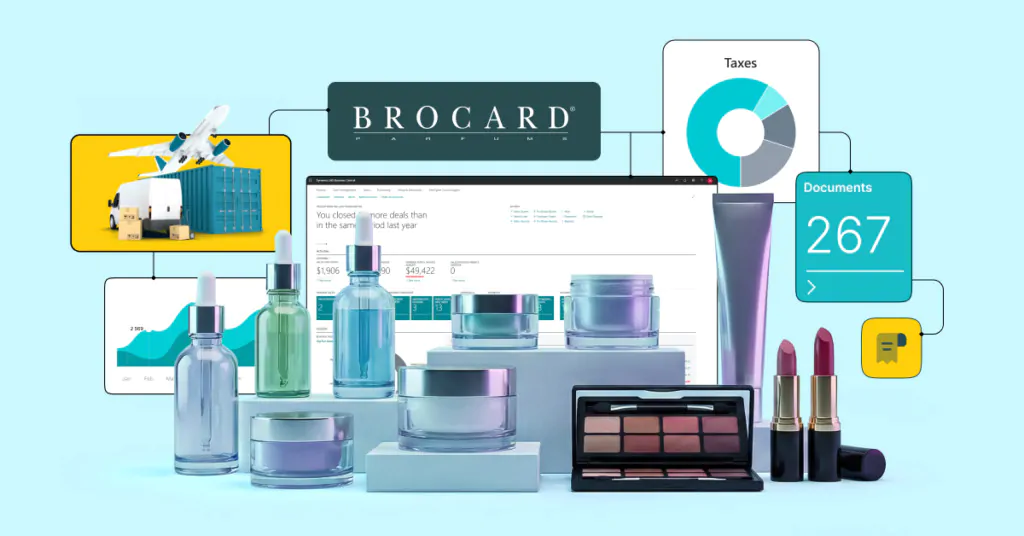
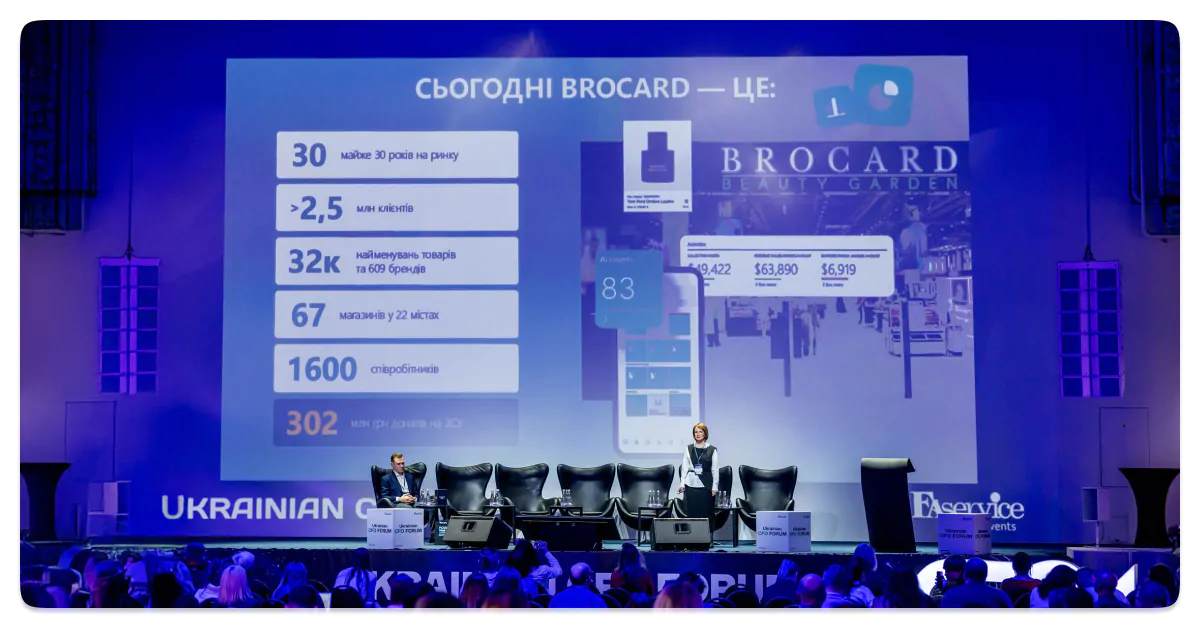
BROCARD is one of the leaders in Ukraine’s premium perfume and cosmetics market, shaping the beauty-luxury culture since 1997. Today, the chain includes 67 stores across 22 cities in Ukraine and offers an assortment of about 32,000 items from more than 600 brands. Over 2.5 million customers trust BROCARD every day — a result of systematic work on quality, reputation, and customer experience.
Such scale demands undeniable professionalism from employees, and BROCARD understands well: growth is impossible without a strong team. The average tenure of specialists at the company is 7.3 years, and in the finance department — 11.6 years, which directly reflects how much the brand values its experts. However, any expertise without technical support usually cannot reach its full potential — that’s why BROCARD continuously updates and transforms its software.
The story of these transformations was presented at CFO 2025 — one of the largest business events that annually brings together thousands of CFOs, executives, and change leaders. On this platform for sharing practical experience, Tetiana Samonenko, Head of Department and Financial Control at BROCARD, shared the results of an eight-year collaboration with SMART business. The speaker explained how the process of technological change began and what goals BROCARD managed to achieve.
The Beginning of Transformation: What Drove the Search for New Software
BROCARD implemented its first CRM system back in 2002. For many years, it provided basic support for business processes, but over time, it began to hold the company back. By 2016, the system’s technological capabilities no longer matched BROCARD’s scale or the demands of modern retail. It could not provide the team with the ability to:
- fully diversify marketing tools
- maintain proper security of customer data
- quickly track inventory across different stores
Data from various sources — online platforms, stores, and standalone internal systems — had to be consolidated manually, which significantly complicated fast managerial decision-making.
At the same time, IT infrastructure requirements were growing. The evolution of modern retail posed new challenges for BROCARD:
- managing millions of SKUs and complex logistics chains
- meeting high customer expectations for uninterrupted service
- delivering hyper-relevant offers and ensuring constant product availability
- mitigating external risks such as supply disruptions, inflation, and labor shortages
To operate effectively under these conditions, the company needed to process massive volumes of data from ERP, CRM, POS, WMS, e-commerce, and dozens of other systems. Manual processes and outdated software could no longer deliver the speed and quality required for business operations.
The next stage of development was clear — BROCARD had to transition to modern software that would enable the company to scale, work with data in real time, and build processes aligned with market challenges.
Hidden Challenges: How BROCARD Overcame Obstacles During Innovation Implementation
The transition to a new technological model at BROCARD was not instantaneous — the company moved through it step by step, overcoming both technical and organizational barriers. First, the approach to interacting with the IT department changed. Just a few years ago, the IT team was involved mainly “when something broke,” and digital solutions were seen as support tools rather than drivers of strategic growth. With the start of digital transformation, the situation changed dramatically: IT became a source of ideas, innovation, and continuous functionality improvement, unlocking virtually unlimited scaling opportunities for the business.
To achieve the best implementation results, the finance and IT departments defined key areas of collaboration:
- joint planning and budget control for digital innovations
- implementation of the new ERP system, Business Central
- fostering a data-driven culture
- staff training and improving digital literacy
An important role in optimization was played by BROCARD’s IT Director — a catalyst for change and innovation driver who successfully combined business vision with technical expertise.
The first major step in the transformation was launching the company’s first online store based on LS Central and migrating back-office processes to a modern system. Before the full-scale invasion, the company managed a network of 96 physical stores, and the scale of these operations required a much more powerful IT architecture.
At the same time, each of these steps coincided with its own challenges:
- COVID-19, which significantly slowed operations and imposed new working conditions
- the start of russia’s full-scale invasion of Ukraine, when the development of the new back office began during the most unstable period
At first glance, this was far from the best time for transformation. However, the BROCARD team decided not to stop.
As a Result, BROCARD Built a Fully Integrated Digital Ecosystem:
- Website — LS Central
- POS Terminals — LS Central
- CRM — Microsoft Dynamics 365 Customer Insights
- Mobile App — LS Central
- Analytics — Power BI, Microsoft Fabric
- ERP — Microsoft Dynamics 365 Business Central
- Office Suite — Microsoft 365
Result #1: Marketing Strategy Transformation
Digital tools completely reshaped BROCARD’s approach to marketing, turning it into an intelligent system powered by accurate data and rapid responses. The company gained deep insights into its customers — not just basic demographics, but real behavioral patterns, preferences, and motivations. Data from all channels flows into the CRM almost in real time, enabling instant reactions to customer actions and the launch of personalized initiatives.
This allowed BROCARD to significantly reduce analysis time, automate segmentation, and boost campaign efficiency. Marketing no longer spends resources “blindly” — every message reaches the right audience, ensuring budget optimization and improved results.
Mobile App: A New Growth Driver
The updated mobile ecosystem brought noticeable changes in customer behavior:
- +20% increase in total sales
- +30% growth in the young audience aged 18–25
- rising share of male customers, who now actively shop for themselves
- session duration in the app is 50% higher than on the website
This confirms that the app has become a full-fledged platform for engagement and personalized service.
AI as a Driver of Innovation
Artificial intelligence is integrated into BROCARD’s daily operations:
- AR makeup try-on lowers purchase barriers and stimulates online sales.
- Zemits Skin Analysis System evaluates skin condition in just 15 seconds — an innovative service that enhances in-store expertise.
- Personalized recommendations, push notifications, and churn risk detection are powered by Customer Data Platform insights and AI algorithms.
As a result, BROCARD now has marketing that not only sells but anticipates customer needs and acts proactively.
Result #2: Inventory Management and Managerial Decision-Making
BROCARD’s upgraded technology infrastructure enabled a complete rethink of inventory management and accelerated managerial decision-making. Daily reports in Power BI are now generated automatically, providing leadership with up-to-date data on sales, margins, stock levels, and key KPIs. Financial reporting is aligned with international standards — with accurate accounting for gift card transactions and online sales — while management reporting reveals a detailed cost structure (supplier prices, delivery, insurance, retro bonuses, etc.).
Automation in store operations delivered a noticeable efficiency boost:
- Goods are now received, transferred, and written off through scanning and automatic results handling, which has increased process speed by 50%.
- No need to route transfers through the central warehouse: products can move directly between stores or even be sold wholesale from retail locations.
- Electronic signatures reduced internal document processing from 10 days to just 1–2 days.
- Software-based cash registers ensure uninterrupted operation — even without internet — for up to 36 hours.
A major breakthrough was inventory management: it’s now done via smartphone and the Microsoft Dynamics 365 Business Central mobile app. This allowed the company to involve only administrative staff (without requiring product experts), and inventory speed increased 2.5 times.
Inventory control also reached a new level thanks to automated replenishment calculations. Overnight, the system compares stock levels with ideal inventory and generates transfer documents from the central warehouse and supplier orders by morning. All procurement activities are governed by an approval system: the commercial department validates supplier cards, and any price discrepancies prevent logistics from processing invoices without confirmation. Additionally, the system measures each supplier’s Service Level.
Even product status management became more transparent: the system allows setting blocks for purchasing, selling, or discount sales. When generating barcodes, the algorithm automatically determines the optimal discount based on shelf life — the shorter the term, the higher the discount — minimizing write-off losses.
BROCARD’s Advice: What to Focus on During Digital Transformation
Digital transformation isn’t just about choosing a platform — it’s about dozens of decisions that determine how effective the system will be in practice. BROCARD highlighted several key recommendations to help companies navigate this journey without unnecessary costs or mistakes:
- Clearly define the required level of customization
Too many custom modifications can complicate future maintenance and updates, as well as inflate the project budget. However, relying solely on standard functionality may not be efficient — every company has unique workflows that software must accommodate. The best approach is to entrust these adjustments to the vendor. - Involve relevant stakeholders from day one
Active participation from the finance team and related departments is critical. They understand internal processes best and can identify risks or discrepancies in software settings early on. - Formulate requirements as clearly as possible
Provide detailed business requirements at the start of the project. This isn’t bureaucracy — it’s real cost savings. Well-defined tasks ensure the technical team implements processes exactly as the business needs. Vague or incomplete requirements often lead to delays and costly rework. - Conduct end-to-end testing with multiple departments
The system works with data created by employees across different teams. A single incorrectly approved item or unnecessary setting can significantly impact financial, logistics, or reporting processes. End-to-end testing is essential to catch errors early — before they become difficult to fix.
The Future Is Here: BROCARD’s Plans for Further Development
BROCARD proves to the world that strategic thinking and confidence in your team can deliver results beyond expectations. A strong corporate culture, internal trust, and a clear customer focus became the foundation that enabled BROCARD to launch one of the most ambitious digital transformations in Ukraine’s beauty retail segment. Today, BROCARD operates the way the modern market will operate tomorrow.
The company isn’t stopping there — it’s already shaping the technological landscape of its future. One of the key priorities will be integrating generative AI into financial operations—from automated budget creation and forecasting to intelligent expense analysis and optimization scenario development. BROCARD also plans to leverage advanced cloud capabilities to scale IT infrastructure, strengthen security, and accelerate data processing. Another focus area is improving cost control and budgeting processes, as well as deepening management accounting to ensure accuracy and transparency in financial decisions.
SMART business continues to help Ukrainian companies grow and expand into international markets. If you’d like to learn more about business process automation and find the right solution for your company, submit a consultation request — SMART business experts will be happy to assist you.